10 free AI business skills, built for everyday work
by Antonio Mora Rives, CTO
A supplier sends another spreadsheet. A customer asks why only half an order arrived. A colleague needs an answer from a procedure that exists in three different versions. These are ordinary business tasks, but doing them well depends on details that a generic AI answer can easily miss.
We have published Free AI Business Skills, a collection of ten open-source workflows for that kind of work. They guide an existing AI assistant through a specific task, using supplied files, explicit business rules, and clear review points.
You can use them independently, without becoming a DEVS AI client. Explore the free skills catalog, or read on to choose a useful first workflow and understand where a skill ends and a connected implementation begins.
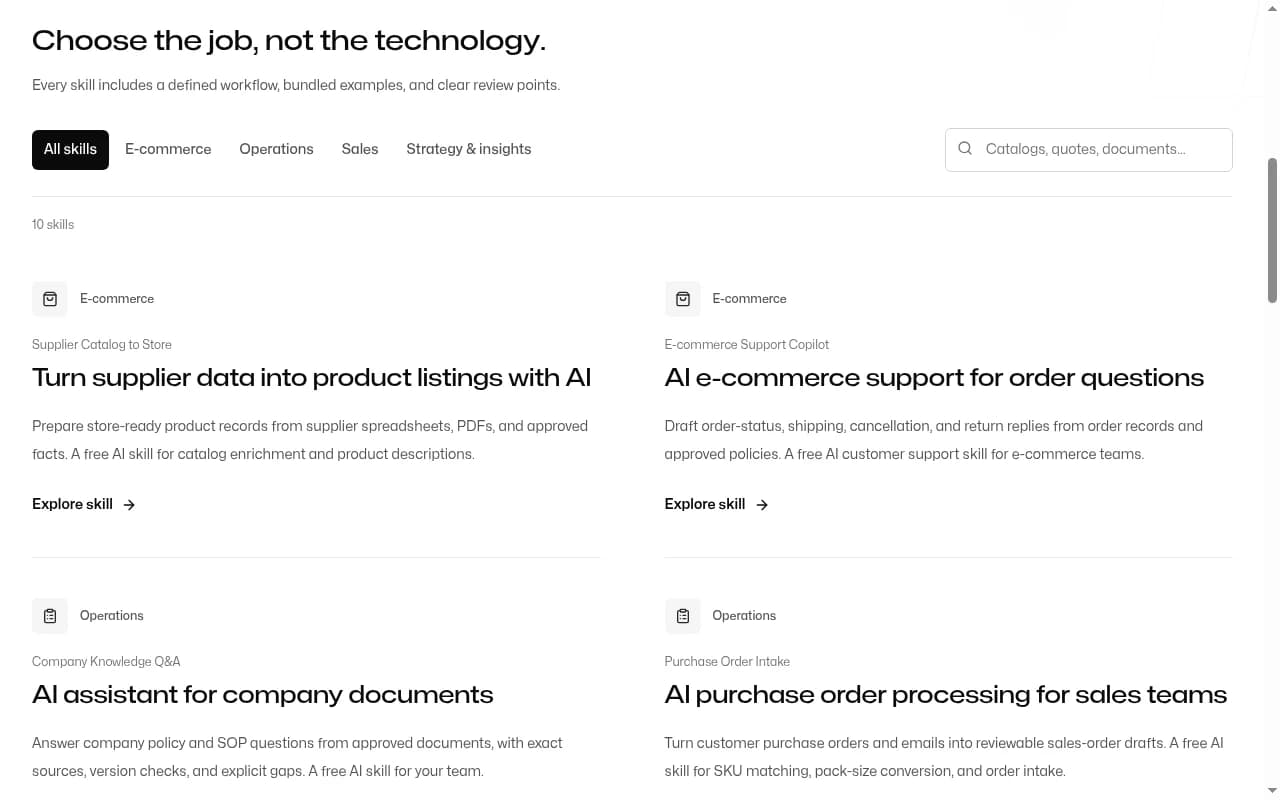
The catalog starts with the business job. Each skill page adds its inputs, expected outputs, installation options, and review boundaries.
- E-commerce
- Customer support
- Company knowledge
- Sales operations
- Workflow automation
Why we built this collection
For business work, a plausible paragraph is often the easy part. The harder questions are whether a product claim came from the supplier, whether a price came from the approved list, or whether a policy applies to the person asking.
We wanted the workflow to make those questions visible. Each skill defines the information to bring, the artifact to produce, and the decisions that should stay with a reviewer. The collection also includes synthetic examples, so you can inspect the approach before introducing company records.
That is the principle behind the release: start with a recognizable business job, preserve the evidence, and make uncertainty reviewable. A missing product specification should remain missing. A conflicting policy should remain a question for its owner. Neither becomes more trustworthy because an assistant writes confidently.
What is an AI business skill?
An AI skill, also called an agent skill, is a reusable package of instructions, resources, and sometimes helper tools that an assistant can load for a particular job. The assistant supplies the model and working environment; the skill supplies a more specific process.
These skills are downloadable workflows, rather than hosted DEVS AI applications. The repository documents setup for Claude Code, Codex, Cursor, GitHub Copilot in VS Code, and Gemini CLI. Discovery and activation depend on the client version and your organization's settings, so explicitly request the named skill and confirm it has loaded.
The skill packages are MIT-licensed. Your chosen assistant, model access, or optional connected services may have separate costs.
Choose a skill by the task on your desk
You do not need to install the whole collection to find out whether it is useful. Start with the job you understand well enough to review.
| Your business task | A skill to try |
|---|---|
| Prepare consistent product records from supplier files | Supplier Catalog to Store |
| Draft replies that account for orders, shipments, and return policies | E-commerce Support Copilot |
| Answer company-document questions with sources and version checks | Company Knowledge Q&A |
| Turn customer purchase orders into matched sales-order drafts | Purchase Order Intake |
| Prototype an editable, rule-based product recommendation quiz | Product Finder Builder |
| Make an operating procedure repeatable and complete one sample | SOP to AI Workflow |
| Prepare a B2B quote draft from an RFQ and approved prices | RFQ to Quote |
| Localize a catalog while preserving IDs, facts, and variants | Multilingual Catalog Launch |
| Link reviews, return reasons, and support feedback to practical fixes | Customer Feedback to Fixes |
| Compare automation options and scope a feasible first pilot | AI Automation Opportunity Finder |
Each skill page explains its inputs, expected outputs, review boundaries, and installation command. The product finder, for example, produces a local rule-based prototype: AI helps create the quiz, but that does not make the finished quiz a live AI recommendation engine.
What this looks like in practice
The following are illustrative situations, not reported customer results.
A supplier catalog with an important gap
Suppose a supplier lists a bottle as stainless steel with a capacity of 750 ml, but says nothing about dishwasher safety. A useful catalog workflow can prepare a title and description from the supplied facts while flagging the missing information. It should not add a dishwasher-safe claim to make the listing sound complete.
That is the distinction the catalog skill is designed to preserve. You still review the product mapping, quantities, variants, and claims before an import. The output is a reviewable set of records, not a promise that everything is ready to publish unattended.
An internal question with two possible answers
A team member asks which travel policy applies to them. You have an older general policy and a newer document for a particular location. The useful answer depends on scope and authority, not just which PDF contains the closest words.
The company-knowledge workflow asks the assistant to cite its sources, check versions, and surface conflicts. If the supplied documents do not establish which policy wins, a responsible result identifies the unresolved question and the person who needs to decide.
A quote with a known price and unknown terms
If an approved price list says a product costs EUR 15 per unit, a request for 20 units gives a line subtotal of EUR 300. That calculation does not supply the tax treatment, an agreed discount, stock availability, or a delivery date.
The quote skill separates supported line items from missing commercial terms. Your sales team remains responsible for approving the offer before it reaches a buyer.
Install the collection, or just one skill
With Node.js and npx available, run this in your project folder to add the collection and follow the installer prompts for your assistant:
npx skills add aidevs-pt/devs-ai-skillsFor a smaller first trial, install only the company-knowledge skill:
npx skills add https://github.com/aidevs-pt/devs-ai-skills --skill company-knowledge-qaIf you use Claude Code, you can install the full collection through its plugin marketplace instead:
/plugin marketplace add aidevs-pt/devs-ai-skills
/plugin install devs-ai-business-skills@devs-ai-marketplace
Use one installation method per assistant to avoid duplicates. The compatibility guide covers client-specific loading and verification. The repository's optional helper tools require Python 3.10 or later.
Top tip
Start with the bundled synthetic example and its supporting files. Ask for the skill by name and confirm it has loaded before introducing company records. This first trial does not need a connection to your business systems.
For example:
Use company-knowledge-qa with the bundled example.
Answer each question from the supplied documents.
Cite the applicable document and version, flag conflicts,
and list any questions the sources cannot resolve.
Review the actual output alongside the example sources. Installing a package and seeing it listed in your assistant is not the same as confirming that the workflow was used correctly.
How to evaluate a first trial
Start with the synthetic example. Then, if your company permits it, use a small representative set of your own records that someone on your team can check.
Before the trial, agree on what a useful result would contain. Check whether:
- Important statements and calculations can be traced to the supplied sources.
- Missing facts and uncertain matches are visible, rather than guessed.
- Product IDs, units, variants, and protected fields remain correct.
- Exceptions reach the right reviewer with enough context to decide.
- Preparing and correcting the output compares favorably with your current process.
Record the corrections and review effort, not just how quickly the first draft appeared. A bundled helper check can verify a specific technical behavior; it does not validate every business rule or prove that a workflow is reliable on your records.
If you are unsure which task to evaluate, start with the automation opportunity finder. It compares process changes, existing software, rules, and AI using the information you supply. The sensible next step may be a better import or a simpler procedure, rather than custom AI.
What the free skills do not replace
The collection is designed around drafts, prototypes, and explicit review. Support replies still need approval. Order drafts do not authorize submission. Quote drafts do not create a commercial commitment. A useful result can be a well-supported exception that a person needs to handle.
Installation does not require sending company files to DEVS AI. However, your chosen assistant may use a cloud-hosted model. Before introducing real records, check its data policy, your company's permissions, and the tools it can access.
A skill file also does not create access controls, audit trails, or reliable connections to your systems. Those belong in the application and integration around it. In particular, a company-document assistant should not gain access to information an employee is not entitled to see simply because that information was included in its context.
When a skill should become a connected workflow
A file-based trial is useful because it makes the job concrete. It can also reveal exactly where manual steps remain: exporting yesterday's orders, locating the current price list, copying approved records into an ERP, or asking someone to check an exception.
A connected implementation becomes worth discussing when you need current data, recurring triggers, permission-aware access, approval gates, monitoring, and a way to recover when inputs change. The review process should be part of that design, not something added after a demo works.
This is where DEVS AI can help: define a feasible scope, connect the relevant systems, and evaluate the workflow against representative work. You can explore our AI implementation services and see our client work to understand the kind of software we build.
If you want to discuss a particular process, tell us about the task, the systems involved, and who approves the result. An anonymized example and a clear description of the current process are more useful starting points than a broad request to "add AI."
Start with one useful job
You do not need a company-wide AI rollout to try a bounded workflow. Choose a task, inspect its example, and decide whether the result is useful enough to keep evaluating.
Browse all ten free AI business skills and choose your starting point.
The skill packages, examples, and installation documentation are available in the DEVS AI Business Skills repository on GitHub.